
Waterfront Parks

Type of Development
New Development, Redevelopment
Topography
Valleys, Baylands
Longevity
Environment
Urban
Maintenance
Medium
Cost
Creating waterfront parks often involves land acquisition, which can be very expensive.
Overview
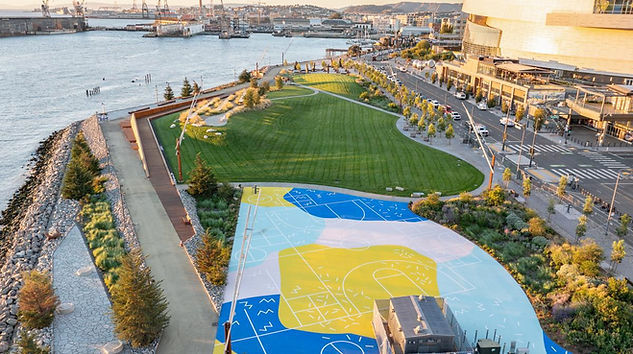
Waterfront parks are intentionally designed to be flooded with minimal damage during storm or flood events. Waterfront parks are often located on previously developed land, like commercial or industrial sites, that has suffered repeated flood damage and no longer serves its original function. Most waterfront parks are created by public entities; however, some private developments may include the creation of a waterfront park as a part the site design. This nature-based solution both minimizes flood impacts and serves as a community recreation space.
Function
Waterfront parks reduce the impacts of flooding by creating a space that can capture and store floodwaters with minimal damage to the park infrastructure.
Benefit
Waterfront parks reduce damages from flooding. They also function as recreational areas that support public health and wellbeing. Moreover, waterfront parks generate attraction and visistors along the waterfront, benefiting local businesses and property values. Waterfront park designs can also support the restoration of floodplain and wetland habitat.
Dependency
Development Considerations
Depending on the current land use and ownership of an area, property buy-outs may be neccessary to create a waterfront park. The process of converting a property into a park may also require permits in accordance with local land use and zoning ordinances.
Environmental Considerations
When deciding the location for a waterfront park, it is important to understand the broader river system and opportunities to most effectively store floodwaters. Converting an area with flooding issues might be less effective than converting a space upstream of flood impacts.
Maintenance Consideration
Besides normal park maintenance, waterfront parks require maintenance for post-flood conditions, particularly to clean and remove settled sediment from a park. Additionally, waterfront parks may require repairs for minor infrastructure damages after a flood.
Cost Considerations
Creating waterfront parks often involves land acquisition, which can be very expensive.
Case Studies

Upper Penitencia Creek Flood Protection
This project is part of an ongoing partnership between Valley Water and the U.S. Army Corps of Engineers, to plan, design and construct improvements along 4.2 miles of Upper Penitencia Creek in Santa Clara. The creek is prone to flooding during extreme precipitation events. To enhance flood protection, the project is implementing both nature-based and grey solutions along the creek. The natural creek channel will be preserved and undergo ecological restoration while adjacent open space and parkland will remain as recreational areas, taking the role as a temporary floodplain so that floodwaters do not enter surrounding neighborhoods and commercial areas.

South Bay Sponge
The South Bay is home to some of the lowest-lying and most vulnerable communities to sea level rise in the San Francisco Bay Area. This area is also growing rapidly without major plans for increasing housing, transit connectivity, or cooperation between jurisdictions. The South Bay Sponge is a new framework for resilience and climate adaptation in the region. The Sponge conceptualizes nature-based solutions and green infrastructure on a large scale. The design includes new landscapes for collecting, filtering, and dispersing flood waters while supporting a variety of habitats. These landscapes include ponds, marshlands, transitional and seasonal wetlands, floodable parks, and green spaces at higher elevations nearby neighborhoods and development. Led by Rebuild by Design, the project is a multi-jurisdictional vision encompassing two counties, one water district, six cities, and at least five federal agencies.